
“No Kings” Protest Day Makes History
Breaking down the biggest protest in U.S. history, how Gen-Z is making waves, and what happens next.
by Hannah Corbitt ★ April 8th, 2026
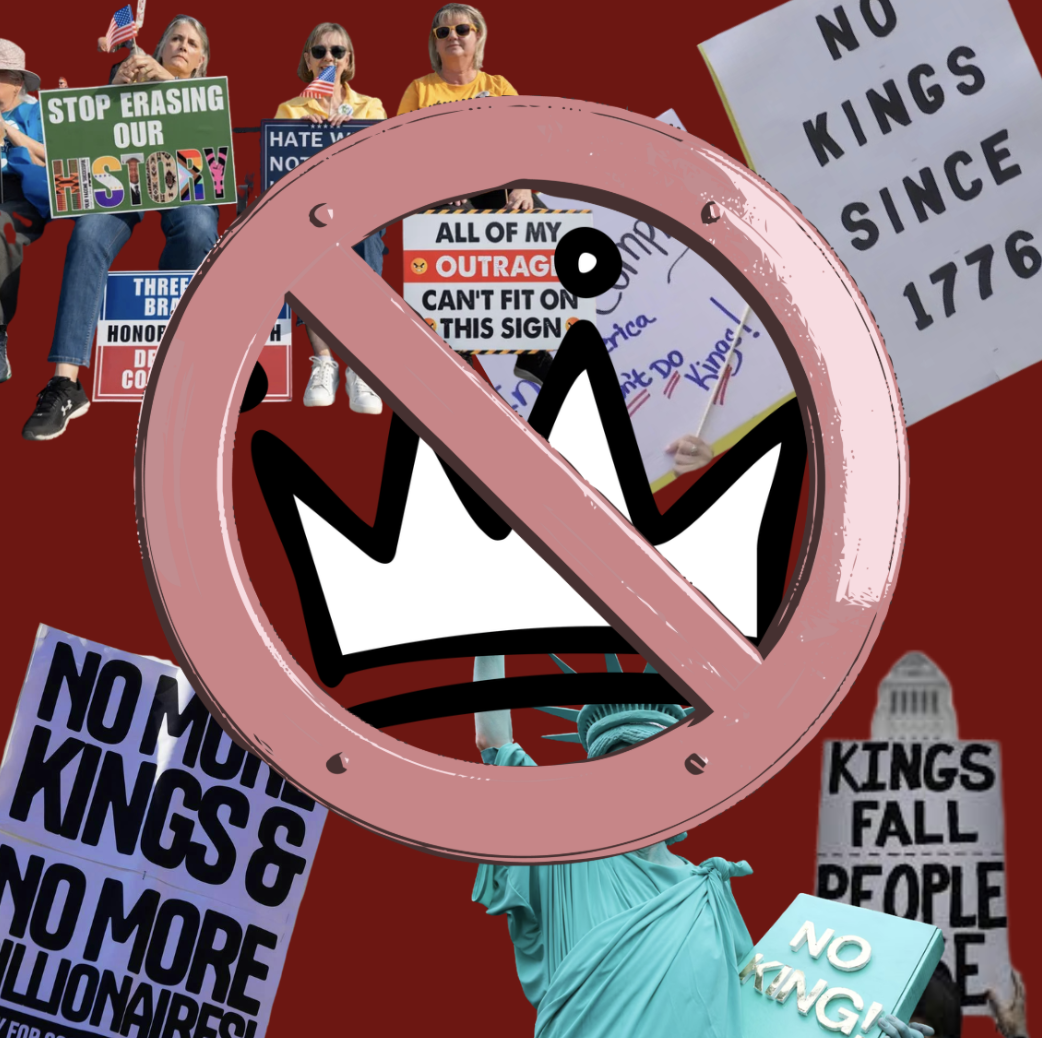
Design by: Maia Simmons
On March 28, millions of people across the United States and around the world participated in what has become one of the largest single-day protest movements in modern history. The “No Kings” protests originated as a response to President Donald Trump and broader concerns about executive power, immigration enforcement, and foreign policy. Participants protested in hopes of preserving the democratic norms they felt were under threat.
The origin of the name, “No Kings,” began when The White House’s official X account posted an artificial intelligence-generated portrait of Trump wearing a crown with the text “LONG LIVE THE KING.” The image was posted alongside an announcement of the repeal of New York City’s congestion pricing. In a press conference uploaded by The Associated Press, New York Gov. Kathy Hochul held up the image and said, “New York hasn’t labored under a king in over 250 years. We sure as hell aren’t going to start now.” People turned to social media in response to the AI image and expressed their growing concerns that Trump would govern as a king.
Participation in the “No Kings” protests was striking, especially in major cities across the U.S. Thousands of people gathered to carry signs, chant slogans and call for political accountability. The protests were livestreamed and documented on social media, calling for citizens in nearby areas to attend and participate in speaking out against Trump’s presidency.
“No Kings” protests were held in every U.S. state and almost every continent, with the flagship event held in Minnesota. More than 8 million people turned out for the largest coordinated mobilization yet against President Trump, motivated by actions viewed as authoritarian and the recent attacks on Iran.
In San Francisco, thousands of participants assembled at Ocean Beach to create a massive “human banner." From above, the formation spelled out: “Trump Must Go NOW – No ICE, No Wars, No Lies, No Kings.” The banner, measuring 300 feet high and more than 600 feet wide, was the latest installment of human artwork organized by travel writer Grad Newsham and architectural designer Travis Van Brasch.
Social media was a key factor in the rapid organization and promotion of these protests and enabled organizers to disseminate information quickly to coordinate these events. Viral videos, protest guides, and digital toolkits helped transform pivotal moments in modern protest movements.
The March 28 protests demonstrated the power of collective action in the digital age. By combining traditional forms of protest with modern communication tools, participants came together and showed support, whether in person or online.
Today, younger generations are taking advantage of political parties’ presence on social media and transforming what used to be dancing and photography apps into places that build community, become major sources of news and information and spread culture and public opinion.
This movement contributed to ongoing political discourse and has secured its place as a landmark in contemporary protest history.
Edited by: Alexa Murland