
What if the very act of trying to capture the truth makes it impossible to do so? “You Can See Everything” makes the case that the camera is never as objective as we think.
BY Sloan Crosson ★ november 1st, 2026
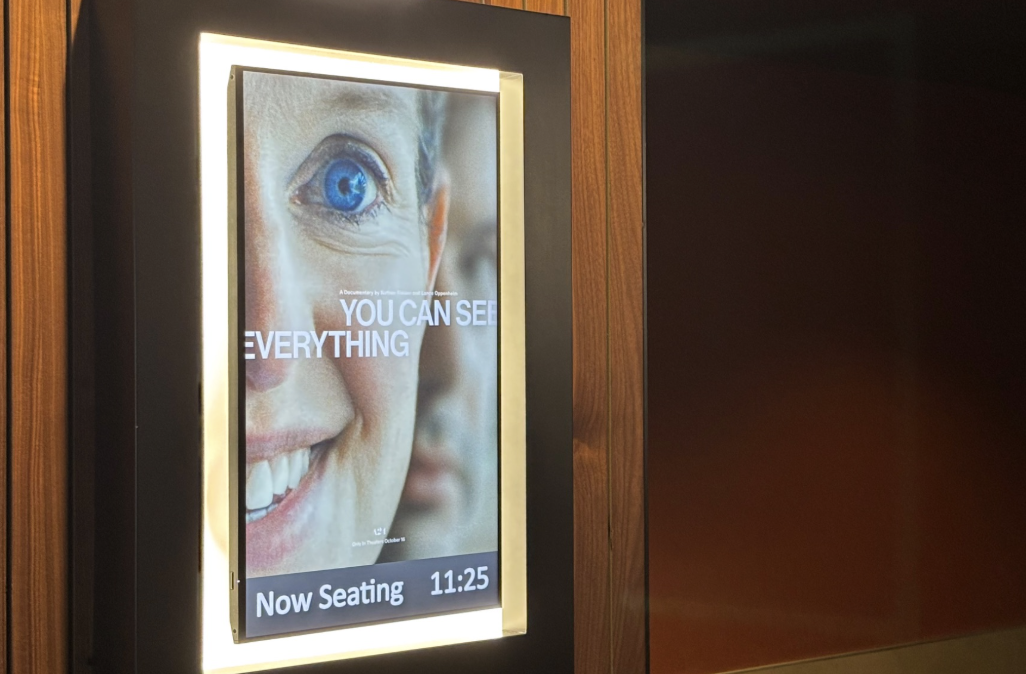
Photo Credits: Sloan Crosson
“I’m not really putting my feelings into this, or I’m trying not to. I’m trying to be accurate.”
Nathan Fielder, director of the new meta-documentary You Can See Everything, makes this admission while attempting to document Elizabeth Holmes, the disgraced founder of Theranos. But as Fielder becomes increasingly involved in Holmes’ life, the distinction between documenting her story and becoming a part of it begins to blur.
“You Can See Everything” follows Holmes, whose blood-testing company collapsed after investigations revealed serious deficiencies in its laboratory practices. Holmes was subsequently convicted of defrauding investors. The film documents the final 34 days before she leaves to serve her 11-year prison sentence. Alongside her husband, Billy Evans, and their children, Holmes allows Fielder complete access to her private life.
A documentary is defined as “a presentation (such as a film or novel) expressing or dealing with factual events." However, “You Can See Everything” is based almost entirely around uncertainty, especially given Holmes’ reputation as a liar and deceiver. This uncertainty becomes especially apparent when Fielder brings in Amanda Seyfried, who portrayed Holmes in "The Dropout," to reenact conversations he remembers having with Holmes. The film becomes something no longer solely based on factual events; it begins to ask us to reconstruct what happened through Fielder’s memory and Seyfried’s performance. Obviously every documentarian brings feelings and a perspective to the work, and every film involves choices about what to include and how to frame it. Still, Fielder’s relationship with Holmes becomes a large part of the story.
In one scene roughly two years into Holmes’ prison sentence, Fielder and Evans discuss a billboard featuring the iconic image of Holmes holding a single drop of blood. Fielder recalls that Holmes previously told him she disliked the photo and cried over how people were using it. Evans counters defensively, insisting that “she doesn’t care about that photo.” Fielder presses him, seemingly standing up for Holmes as he recalls a more vulnerable side of her.
Evans’ influence over Holmes’ public image goes far beyond circulating a billboard. While she is in prison, Evans obtains power of attorney and contacts executives at X to gain access to her account. With Holmes unable to communicate directly with the public, it becomes difficult to know which statements reflect her own views and which come from her husband. When someone asks Holmes on X whether she has watched “The Dropout,” Evans responds on her behalf writing "never will," despite footage of Holmes watching clips from the series with Fielder and her family. Fielder worries that the documentary’s release will make this response appear dishonest, further damaging Holmes’ already troubled reputation. The situation complicates the image of Holmes as a habitual liar: if someone else is speaking for her, how can we know whose words we are judging? Fielder’s concern for how Holmes is portrayed reveals how personally invested he has become in distinguishing her own actions from the actions of those around her.
These moments invite viewers, including Fielder, to feel sympathy for Holmes. Seeing her husband speak on her behalf and exert control over her public image makes it difficult not to wonder whether she too is being misrepresented. Seyfried even expresses a similar emotional investment as she reflects on Holmes, but the film never allows that sympathy to settle comfortably. What if Holmes is more aware of what is happening than she lets on? What if her apparent vulnerability is itself a part of the performance? As much as we would like to believe her, it’s difficult. Believing her requires us to take her at her word, something her history makes nearly impossible.
Despite all the negative public perception surrounding her, Fielder is surprised by how inviting Holmes can be. As he tries to reconcile the woman he knows with the person the public believes her to be, he begins to question which version of Holmes is real. He even acknowledges that “everything points to someone having nothing to hide,” while recognizing that she is the only person he has to go on. As Fielder further develops his sense of Holmes and her experiences, his perception changes the questions he asks and the meaning he assigns to the evidence.
At the start, Fielder wasn’t planning on being in front of the camera. In an IndieWire interview, Lance Oppenheim, the film’s other director and producer, explains how he first approached Fielder by cold email. The two eventually became friends, discussing television, movies, and their personal lives, before Oppenheim began pitching ideas for a project they could work on together. None seemed to stick until Holmes’ name came up during a night out. Oppenheim recalled that Holmes had approached A24 seeking a documentary crew to document her life before prison. Without a clear angle in mind, the filmmakers decided to visit her home and see what unfolded. From their first interactions with Holmes, they knew they had reason to stay.
Even from the first day of filming, Oppenheim described how “it felt like they were kind of drawing Nathan almost in front of the camera.” Holmes and Evans would ask Fielder his opinions, and the crew eventually figured, with Fielder’s ability to connect with people, that Fielder should become more involved. Oppenheim described the result as “the most vulnerable I've ever seen him,” and “the closest to the person of Nathan that exists.”
Ultimately, “You Can See Everything” is as much about Fielder’s attempt to understand Holmes as it is about Holmes herself. By placing himself so deeply within her life, he captures an intimacy that a more distant filmmaker might never achieve. But that closeness also makes it difficult to separate what he witnesses from what he feels, or what he knows from what he believes he knows. The film repeatedly asks us to consider whether Holmes is being honest, whether Evans is speaking for her, and whether Fielder’s own sympathy is shaping what we see.
Maybe this uncertainty is the point. No documentary can present reality without making choices about what to show and how to interpret it. “You Can See Everything” takes that problem a step further by making the filmmaker’s personal involvement central to the story. Fielder may be trying to be accurate, but accuracy is not simply a matter of recording events; it also requires recognizing the limits of one’s own perspective. In trying to understand Holmes, Fielder reveals just how difficult it is to tell someone’s story without becoming part of it.
Edited by Zara Abiog